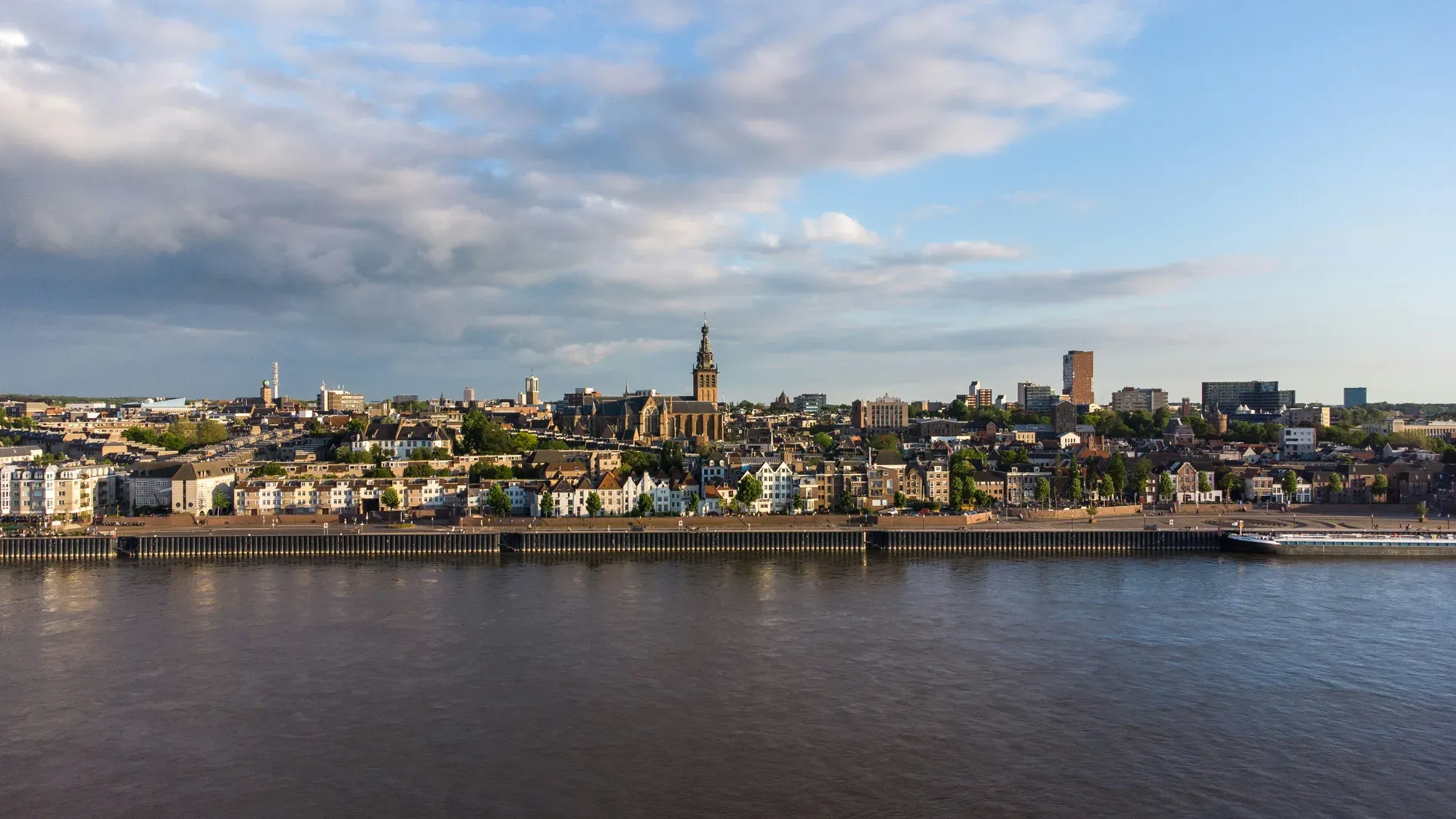
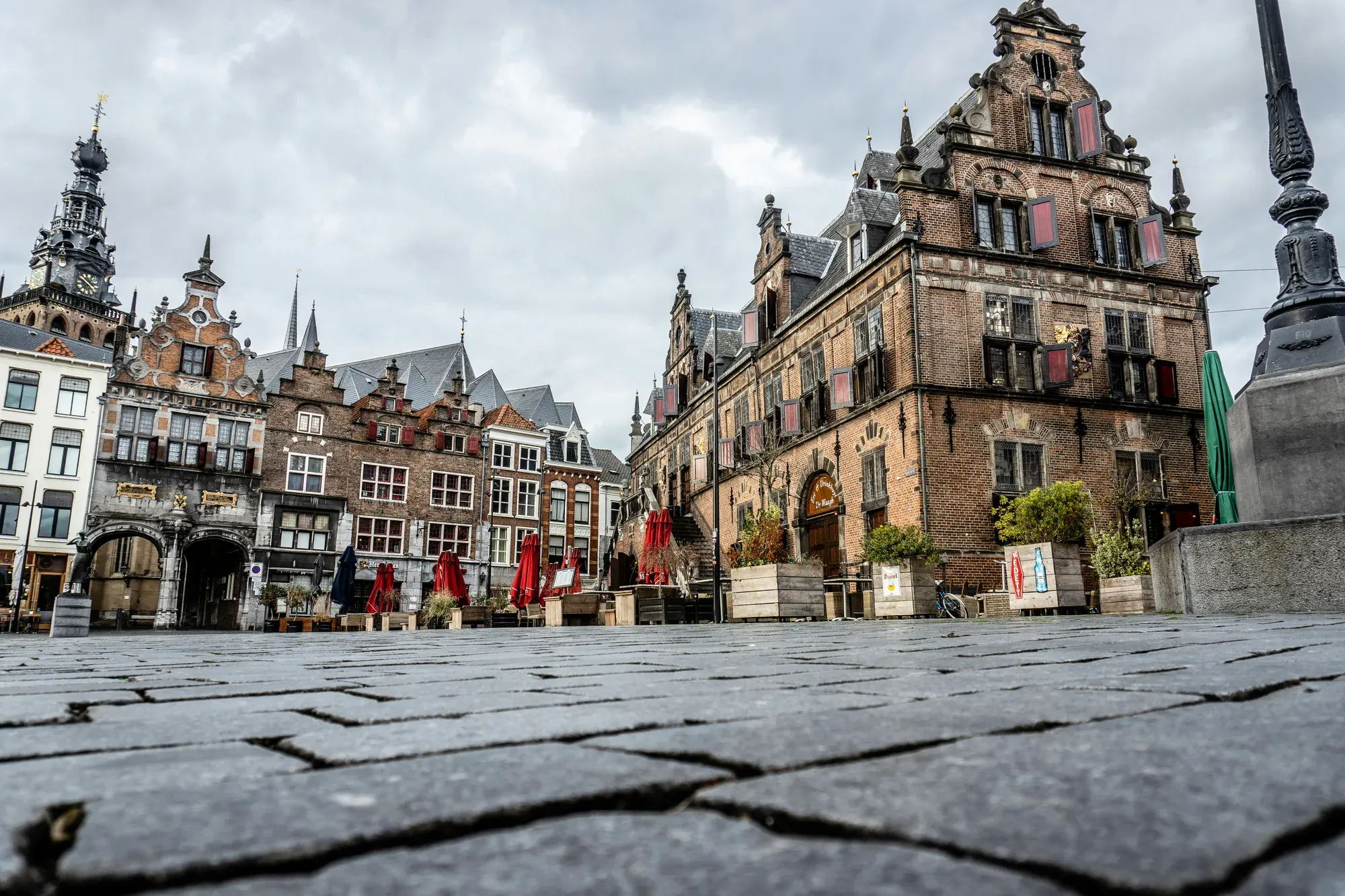
Nijmegen is the oldest city in the Netherlands, granted Roman market and city rights by the Emperor Trajan around 100 AD, and it is also one of the most damaged. On 22 February 1944 a misdirected American bombing raid cut a swathe from the Valkhof to the railway station and killed close to eight hundred civilians, and the September fighting for the Waal bridges burned much of what was left. What makes the city worth a day is that both cities are still visible at once: the medieval Grote Markt and the Sint-Stevenskerk that survived, and the post-war rebuild that fills the gaps, on real hills above a very wide river.
Known forRoman origins, Market Garden, the Vierdaagse
Time neededTwo hours for the centre
Getting thereDirect intercity, about 1h20 from Amsterdam
The oldest city in the Netherlands and one of the most damaged in 1944: from Charlemagne's Valkhof to the Waal bridges, what survived and what was rebuilt.
A bluff above the Waal where the Romans built, and where Charlemagne held his palace in 777. The fortress was demolished in 1796 and citizens' protest saved two fragments: the Sint-Nicolaaskapel and the Barbarossa ruin. It is the oldest park in the city and the view over the river is the best in town.
Free and always open. The climb up from the centre is gentle, the descent to the quay is steeper and has steps.
Begun in 1254 and dedicated in 1273 by Albertus Magnus. The tower and the streets around it took the worst of the 1944 raid, and restoration ran for roughly twenty-five years before it reopened. It was very badly damaged, not destroyed, and the difference is visible inside.
Usually open daily around 10:00 to 17:00. From April to September a guild guide takes visitors up the tower, as a separate climb and a separate ticket.
The Waalbrug was opened by Queen Wilhelmina in 1936 and its 244-metre arch was then the longest in Europe. Downstream is De Oversteek, opened in 2013 and named for the 1944 crossing, whose forty-eight pairs of lights are lit one pair at a time each evening while a veteran walks the bridge in silence.
The Sunset March happens every evening at sunset, whatever the weather. Anyone can join and walk with the veteran.
Billed as the oldest shopping street in the Netherlands, now full of independent shops, and home to Cafe In de Blaauwe Hand, whose hospitality tradition is dated to 1542. It was among the areas worst hit on 22 February 1944.
The Stikke Hezelstraat end climbs steadily up to the Grote Markt. It is the steepest few minutes in the centre.
Het Valkhof on Kelfkensbos holds the Roman archaeology that makes the oldest-city claim concrete. De Bastei, on the Waalkade, is built into a 16th-century bastion and covers two thousand years of building alongside the river, with an underground archaeological route.
De Bastei is the better wet-weather option and sits right at the end of a river walk.
The International Four Days Marches is the largest walking event in the world: more than forty-five thousand people from over seventy countries walking thirty, forty or fifty kilometres a day for four days in the third week of July, with a week of festivities filling the centre.
Extraordinary to witness and extremely busy. Routes are diverted and normal tours are constrained, so book far ahead and expect a modified route.
Getting thereNijmegen Centraal has direct intercity trains from Amsterdam in about an hour and twenty minutes, Utrecht in about forty minutes, and Arnhem in about fifteen. The centre is a ten-minute walk from the station, slightly uphill.
Getting aroundOn foot. The old centre sits on an ice-pushed ridge above the Waal and covers roughly two and a half kilometres of walking, with two modest climbs and one steeper descent with steps down to the quay.
Best time to visitMorning, roughly 10:00 to 12:00, gives you the Stevenskerk open and the Grote Markt before the lunch rush. Late afternoon is better for light on the river, since the Belvedere and the Waalkade both face north over the water.
Time neededTwo hours for the centre. Half a day if you add a museum, a full day if you want the tower climb and the river.
Tickets & passesThe Stevenskerk is normally free to enter, with the tower climb ticketed separately. Museum entrance fees are not included in a walking tour.
From our guides
Worth knowing before you go
Nijmegen has actual hills, which almost nowhere else in the Netherlands does. A city route over the same ground records heights from six to forty metres. Wear shoes you can walk a slope in.
The 1944 bombing was long called the forgotten bombing in the Netherlands, because it was Allied. Locals will tell you about it if you ask, and it is a large part of why the centre looks the way it does.
Time an early-evening visit to finish near the Sunset March. Walking the bridge at dusk with the veteran is the single most memorable thing you can do here, and it costs nothing.
Gallery
Nijmegen in pictures
Plan your visit
Useful links
Official sources, so you can check today's hours and prices rather than trusting ours. All open in a new tab.
Coach set-down and parking in Nijmegen changes during the Vierdaagse week in July, when large parts of the centre are closed to traffic. Confirm the current arrangement with the city before travelling.
Is Nijmegen really the oldest city in the Netherlands?
It has the strongest claim. A Roman military camp stood here in the 1st century BC, the settlement was renamed Ulpia Noviomagus Batavorum under Trajan around 100 AD and received Roman city and market rights then, and Dutch city rights followed in 1230. Maastricht contests the title, and the argument turns on whether you count the Roman town or continuous city rights. Both cities are used to being asked.
What happened on 22 February 1944?
American bombers, thrown off by cloud, German fighter attacks and unnoticed wind drift, released their loads over Nijmegen instead of their German target. Bombs fell in a line from the Valkhof to the station area and close to eight hundred people were killed, among them twenty-four children and eight nuns at a Montessori kindergarten and convent.
How much of the old city is still there?
Less than you would expect. Across the war the city lost more than two thousand two hundred residents, around five thousand houses were destroyed and thirteen thousand more badly damaged. What survived is worth the walk: the Grote Markt with De Waagh of 1612, the Stevenskerk shell, the Lange Hezelstraat, the Kruittoren and the Valkhof fragments. Reading the difference between what survived and what was rebuilt is a large part of what makes the city interesting.
Where does Operation Market Garden come in?
The road and rail bridges over the Waal were the second-to-last objective on the road to Arnhem. On the afternoon of 20 September 1944 men of the 82nd Airborne crossed the river downstream of the city in canvas assault boats in daylight. More than half of the roughly two hundred and sixty men in the first wave were killed or wounded. The bridges were taken that day.
Is the walking difficult?
It is the hilliest city centre in the Netherlands, which is a low bar but a real one. There are two modest climbs and one steeper descent with steps from the Valkhof down to the Waalkade. Anyone comfortable on their feet for two hours is fine, and a guide can route around the steps if you say so in advance.
Help us make this site better. Cookies show us which pages confuse people, so we can fix them, and which of our ads lead to bookings. With your yes, we can also show you our tours later on Facebook and Instagram. We never sell your data, and you can change your choice any time. Privacy policy Cookies help us fix pages and run our ads, also on Facebook.
Your cookie choices
Cookies are small files a website leaves in your browser so it can recognise it later. We use them for four things and nothing else: keeping the booking process working, seeing where visitors get stuck so we can fix those pages, knowing which of our ads led to a booking, and, if you allow it, showing you our tours again on Facebook and Instagram. We never sell your data.
Strictly necessary
Always on
Keeps your booking and payment session with our checkout provider Mollie alive, protects the forms against abuse, and remembers the choice you make here for six months. No tracking, no profiling, and nothing is shared for marketing. The site cannot work without these, so they cannot be switched off.
Microsoft Clarity and PostHog show us which pages people leave, where they hesitate, and what they never find. On: they can recognise your browser across pages and repeat visits, and record a replay of your visit with anything you type hidden. That means cookies: Clarity’s _clck (1 year) and _clsk (1 day), and PostHog’s own cookie (1 year). Off: no cookies, and nothing stored on your device. Both still count the pages you view, and PostHog ties the pages of a single visit together using a code built from your IP address and browser that is renewed every day and cannot be turned back into either. So we can see that one visit read three pages, and we cannot recognise you tomorrow. Clarity does still replay how each single page is used, with anything you type hidden, but it cannot link one page to the next. No profile, and no linking one day to the next.
Run for us by Microsoft Ireland Operations Ltd and PostHog Inc. Neither is allowed to sell this data or use it for advertising.
If you reached us through one of our Google ads, Google’s tag notes whether that visit ended in a booking, so we only keep paying for ads that work. On: Google sets the cookie _gcl_au (90 days) on this site, plus _gcl_aw (90 days) when you arrive from an ad, and receives the booking amount and its reference. Off: Google’s tag is not loaded at all. Meta’s pixel tells Meta which pages of this site you visited and whether you booked, so we can measure our Facebook and Instagram ads and show you our tours there again (retargeting). On: Meta sets the cookie _fbp (90 days), plus _fbc (90 days) when you arrive from one of our Meta ads. Off: Meta’s pixel is not loaded at all. Google’s tag is never used for retargeting.
Provided by Google Ireland Ltd and Meta Platforms Ireland Ltd, which each handle this data under their own advertising terms and privacy policy.
Whatever you pick, you can change it later from the privacy policy, and changing it to off deletes the cookies again.