How to get to Kinderdijk without a car: from Rotterdam, The Hague and Amsterdam
September 6, 2026 · by Robin Lenskens
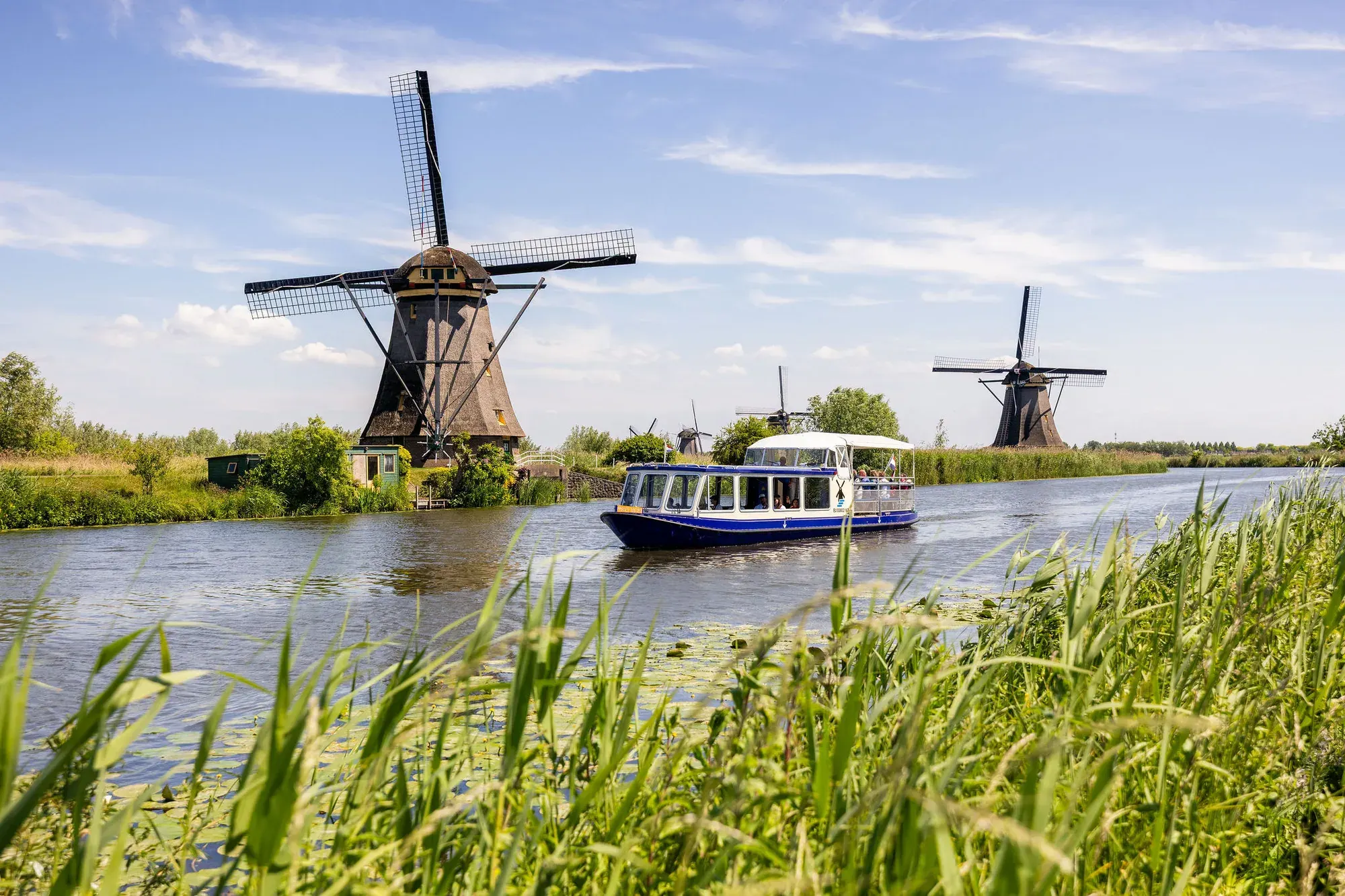
You do not need a car for Kinderdijk. From Rotterdam the WaterShuttle sails from the Willemskade, next to the Erasmusbrug, to the entrance of the windmill area in about 30 minutes; the alternatives are the regular Waterbus line 20 with a short ferry crossing at Ridderkerk, or bus 489 from Kralingse Zoom metro station. From The Hague and Amsterdam you take the train to Rotterdam Centraal first and then one of those three. The windmills themselves are free to walk along all year; you only pay if you want the museum mills, the pumping station and the boat.
What is the fastest way from Rotterdam to Kinderdijk?
The WaterShuttle. It is a direct boat run by Waterbus in cooperation with the Kinderdijk foundation, from the Willemskade stop on the north bank of the Maas (at the Erasmusbrug) to Kinderdijk Molenkade, which is a few minutes on foot from the visitor centre. The crossing takes around 30 minutes and you can take a bike on board for free.
It is a tourist service, not public transport, so you cannot check in with your bank card or OV-chipkaart. Fares at the time of writing are €9.75 one way and €19.50 return for adults, half price for children aged 4 to 11, and free under 4. Kinderdijk also sells a combi ticket with the boat return and the site entrance together on kinderdijk.com.
Does the WaterShuttle run every day?
No. Until 5 October 2025 the boat was an ordinary Waterbus line (line 21) that sailed daily. From 6 October 2025 it became the WaterShuttle, and Waterbus states that it sails on Fridays, Saturdays and Sundays. The summer timetable has several sailings a day in each direction; the winter timetable is much thinner. In winter 2025/2026 it left Rotterdam at 09:15 on Friday and 10:15 on Saturday and Sunday, with one return from Kinderdijk at 17:45, which gives you a full day at the mills but no flexibility. On Monday to Thursday there is no direct boat in any season.
The current timetable is published as a PDF on the Waterbus WaterShuttle page. Check it before you plan a day around the boat, and use the Waterbus line 20 route or bus 489 on the days it does not sail.
How to reach the WaterShuttle pier from Rotterdam Centraal
The pier is at the Willemskade, on the city side of the Erasmusbrug. Normally tram 7 from Rotterdam Centraal takes you to Willemsplein, next to the pier. In 2026 that does not work: because of works at Hofplein, RET has diverted tram 7 and several other lines from 18 July 2026 until 23 November 2026, and tram 7 currently skips Rotterdam Centraal and Willemsplein altogether. The simple alternative is the metro: take line D or E from Rotterdam Centraal to Leuvehaven (two stops) and walk down to the river, a few minutes on foot. Check the RET status page for the current diversions, and use 9292.nl for door-to-door planning on the day.
The Waterbus and ferry route via Ridderkerk
When the WaterShuttle is not sailing, or if you prefer public transport fares, take Waterbus line 20. It runs every half hour between Rotterdam Erasmusbrug and Dordrecht Merwekade, with stops at Ridderkerk De Schans and Alblasserdam Kade on the way, and you check in with a contactless bank card (OVpay) or an OV-chipkaart like any bus or tram.
Get off at Ridderkerk De Schans and change to the Driehoeksveer, a small passenger and bicycle ferry that connects Ridderkerk, Kinderdijk and Krimpen aan de Lek. The crossing to Kinderdijk takes about 10 minutes. The ferry is not part of Waterbus, so your Waterbus check-in does not cover it: you pay on board, contactless only, €2.35 per adult (12 and over), €1.45 for children 4 to 11, free under 4. The ferry runs roughly every 30 minutes through the middle of the day on weekdays; on Saturdays, Sundays and public holidays it starts late in the morning, around 11:00, so it is not the route for an early weekend start. The current timetable is on the Blue Amigo Driehoeksveer page.
A second option on the same line: stay on to Alblasserdam Kade and cycle to the Kinderdijk entrance in about 15 minutes. Bikes travel free on the Waterbus. On foot it is around an hour along the dike, which is pleasant on a fine day but not a shortcut.
Bus 489: the all-year public transport option
Bus 489 runs from Rotterdam Kralingse Zoom to Kinderdijk Molenkade in about 35 minutes, twice an hour, seven days a week. Kralingse Zoom is a metro station on lines A, B and C, so from Rotterdam Centraal you take the metro east and change to the bus. Kinderdijk’s own public transport page also lists tram 23 to P+R Beverwaard with a change to bus 489 for anyone starting on the south bank. Count on roughly an hour door to door from Rotterdam Centraal.
The bus is the least scenic of the three routes but the most dependable: it does not depend on the season, the wind or the ferry timetable. On a windy day it is also the only one that is guaranteed, because the Kinderdijk tour boats and the small ferry can be kept ashore in strong wind.
From The Hague
Take the train to Rotterdam Centraal and continue with any of the routes above. NS lists Den Haag to Rotterdam from €6.40 one way, and there are frequent Intercity and Sprinter services; see the NS journey planner for today’s times and any engineering work, which was frequent on this stretch in 2026. Allow around two hours from The Hague to the windmills including the change in Rotterdam, and the same back.
If you are staying in The Hague or Delft, the WaterShuttle is the route to aim for on a Friday, Saturday or Sunday: it removes one change and turns the last leg into a river trip past the port. On a Monday to Thursday, plan on bus 489 or the Waterbus and ferry.
From Amsterdam
Train to Rotterdam Centraal, then WaterShuttle, Waterbus or bus. The Intercity Direct via Schiphol is the fast train; the regular Intercity via Haarlem and Leiden takes longer. Check the NS planner for times and fares. It is a long day from Amsterdam, realistically three hours of travel each way with the connections, so most people combine it with a few hours in Rotterdam rather than going straight back. Our one-day Rotterdam guide on this blog covers what to do with that time.
From Dordrecht
Dordrecht is the other natural base. Waterbus line 20 runs from Dordrecht Merwekade to Rotterdam via Alblasserdam and Ridderkerk, so the ferry route works from this side too. By bus, Kinderdijk lists line 93 once an hour Monday to Friday from platform B at Dordrecht station straight to Kinderdijk, and line 416 every half hour, seven days a week, to Alblasserdam Makado with a change to bus 489. For the return on line 93, you take bus 489 to Nieuw-Lekkerland, where the same bus continues as line 93 to Dordrecht.
Kinderdijk tickets and opening hours
Walking or cycling the public path along the mills is free, every day of the year, including outside opening hours. The paid ticket covers the visitor centre and its film, the museum mills (Nederwaard, built in 1738, and Blokweer, from 1630), the Wisboom pumping station, the tour boats and the audio tour in the Kinderdijk app. Kinderdijk sells tickets on its own site at a discount against the entrance price; the standard adult price is around €21.00 at the time of writing, with a lower rate for children aged 4 to 12 and free entry under 4. Confirm the current figures in the Kinderdijk ticket shop before you go. A separate guided-tour ticket (a 1.5-hour walk in English at 12:30 with entrance included) costs €25.90.
| Period (2026) | Opening hours |
|---|---|
| 6 March to 1 November | 09:00 to 17:30 daily |
| 2 November to end of December | 10:30 to 16:00 daily |
| Early January | Open 2 to 4 January, closed 5 to 22 January |
| 23 January to 5 March | Friday to Sunday only, 10:30 to 16:00 |
| 25 December | Closed |
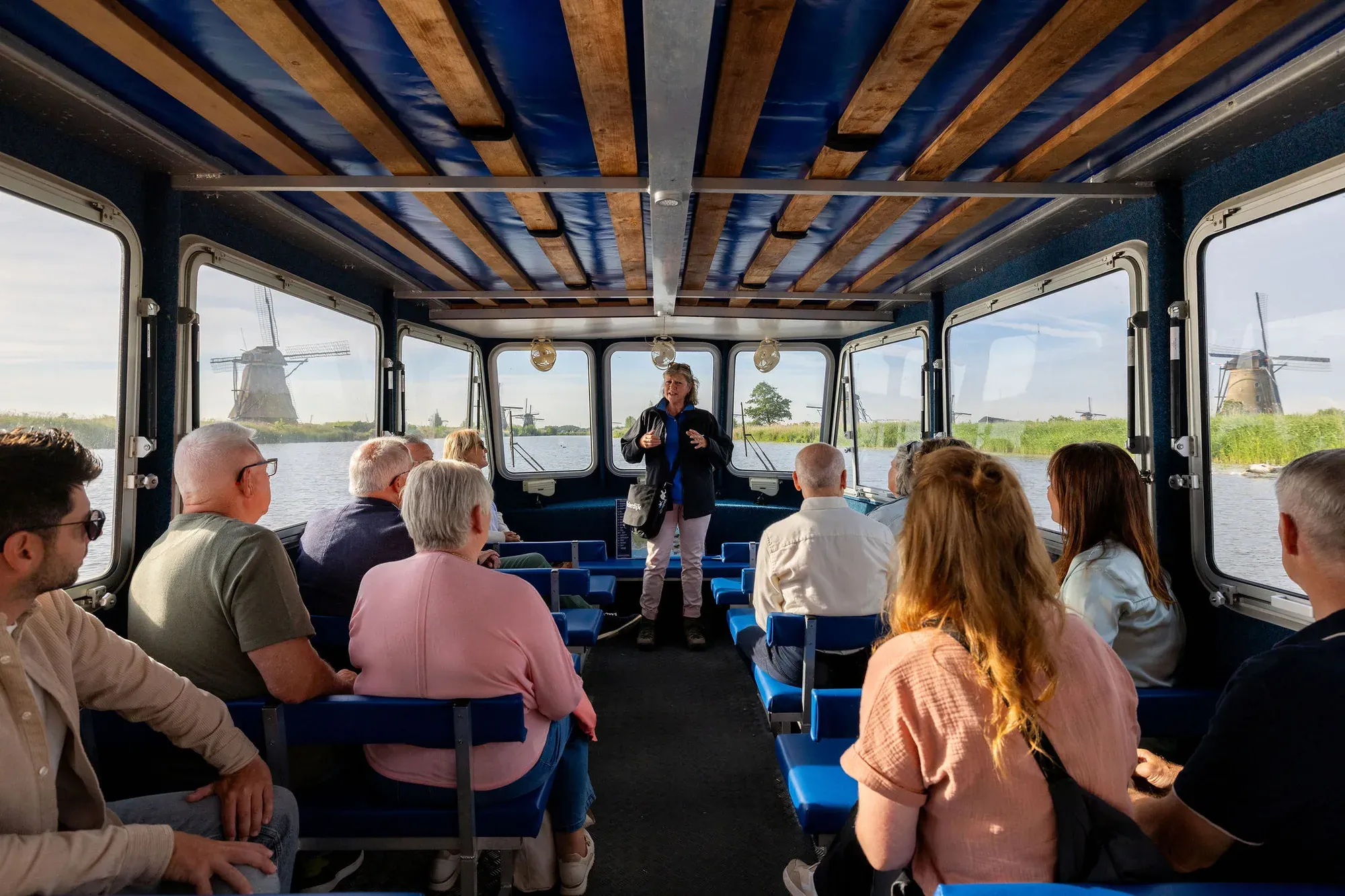
The 2027 pattern should be similar, but check the opening hours page for exact dates. Two boats run on the ticket: the Hopper, which shuttles along the canal and stops at both museum mills, and the Cruiser, a 30-minute round trip to the far end of the Overwaard that operates from April to the end of October. The last boat leaves half an hour before closing. Neither can be reserved, and both stay ashore in strong wind.
If you do arrive by car after all, parking at the entrance costs €9.75 per car from 2026, cannot be reserved and fills up on busy days, which is one more reason to leave it behind.
When do the windmills turn?
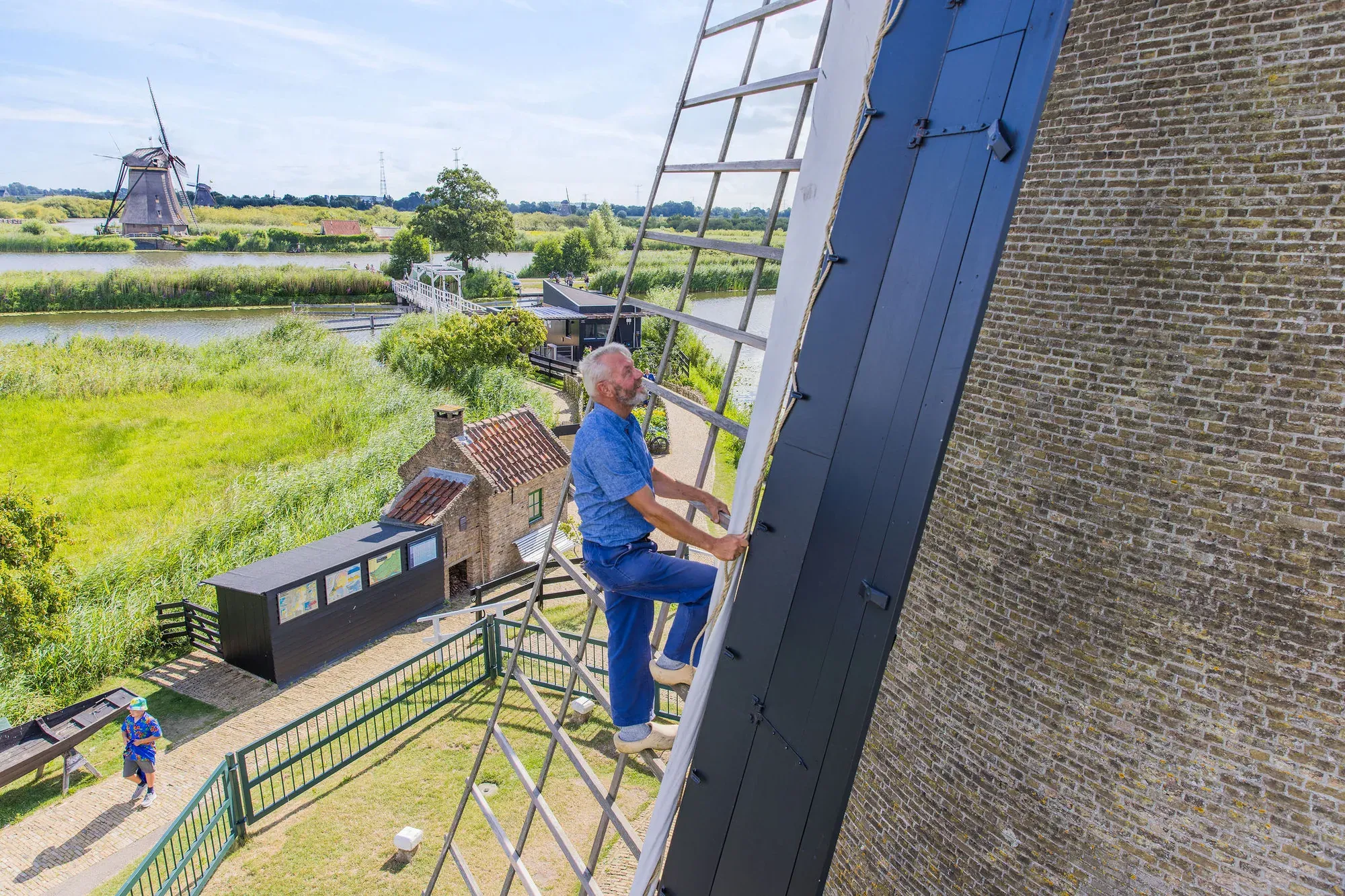
Not every day. The 19 mills are historic drainage mills, part of a UNESCO World Heritage site since 1997, and modern pumping stations now do the work. Millers still live in most of the mills and turn them regularly for maintenance and for visitors, most often at weekends and on busy days, when there is enough wind. National Windmill Day is the second weekend of May every year (9 and 10 May in 2026, which puts it on 8 and 9 May in 2027) and is the one date when as many mills as possible across the country are set turning. Kinderdijk also lights up all 19 mills for one week each September, with evening boat trips; in 2026 that was 2 to 7 September.
How much time to plan
Two to three hours on site is right for most visitors: the film at the visitor centre, one or both museum mills, the boat one way and the walk back along the dike. Add the travel: a Rotterdam-based day using the WaterShuttle is comfortably done in half a day, which leaves the afternoon for the city. Using the ferry or bus routes, allow four to five hours from Rotterdam Centraal and back.
Combining Kinderdijk with Rotterdam or Dordrecht
The natural pairing from Rotterdam is a morning at the mills and an afternoon in the city, or the reverse if you want the mills in the softer late-afternoon light. A private walking tour of Rotterdam starts at Station Blaak, two metro stops from the Willemskade area, so the two fit together without backtracking.
From Dordrecht the day is quieter and more historic: the oldest city of the province, with a compact centre of merchant houses and harbours, and a Waterbus link to the mills. A private walking tour of Dordrecht takes 1.5 hours and combines well with the ferry route in either direction.
Accessibility
The site is flat, with a paved path along the mills, and both tour boats are wheelchair accessible. The distances are the thing to plan for: the path from the entrance to the far mills is a couple of kilometres each way, and the museum mills themselves have steep internal ladders that are not suitable for everyone. Using the Hopper boat one way and walking back shortens the route without missing anything. Cyclists have it easiest, and the WaterShuttle and Waterbus both carry bikes free.
Frequently asked questions
Is Kinderdijk free to visit?
Walking or cycling along the mills on the public path is free and possible all year, even when the visitor centre is closed. You pay only for the ticketed parts: the museum mills, the Wisboom pumping station, the film and the boats. If you just want the view and the photographs, you can see the whole row of mills without a ticket.
How long does the boat from Rotterdam to Kinderdijk take?
The WaterShuttle takes about 30 minutes from the Willemskade at the Erasmusbrug to Kinderdijk Molenkade. The Waterbus line 20 route with the change to the ferry at Ridderkerk takes longer, roughly 45 minutes to an hour depending on the connection, because the ferry runs to its own timetable and is not timed to the Waterbus.
Can I do Kinderdijk as a day trip from Amsterdam by public transport?
Yes, but it is a long day: train to Rotterdam Centraal, then boat or bus, roughly three hours each way including connections. If you are only in the Netherlands for a few days and based in Amsterdam, the Zaanse Schans is much closer; our Kinderdijk or Zaanse Schans comparison explains which suits which visitor.
Can I take a bike to Kinderdijk?
Yes. Bikes travel free on the WaterShuttle and the Waterbus, and the Driehoeksveer ferry carries bikes as well. Cycling is not allowed inside the paid areas, but the public path along the mills is a cycle path, and the ride from Alblasserdam Kade to the entrance takes about 15 minutes.
What is the best time of day at Kinderdijk?
Early, at 09:00 when the site opens, or after 15:00. Coaches and cruise groups arrive from mid-morning and the path in front of the first mills gets busy until early afternoon. Late afternoon has better light for photographs and, on a breezy weekend, the best chance of seeing mills turning.
Is there anywhere to eat?
There is a café at the visitor centre and a few places in the village, but it is a small site. If you are on a tight schedule, eat in Rotterdam or Dordrecht before or after, or bring something for the benches along the dike.
Visiting Kinderdijk with us
If you are arriving on a cruise ship at Rotterdam, our Delft and Kinderdijk shore excursion covers the transport and the timing so you are back on board with margin. Independent visitors who want the story without a group can use our self-guided audio tour of Kinderdijk for €7.99, and there is a full overview of the site on our Kinderdijk destination page. For a private guided day that pairs the mills with Rotterdam, Dordrecht or Delft, tell us your dates on the plan my trip page.