
Why The Hague is not the capital of the Netherlands
· by Robin Lenskens · Updated
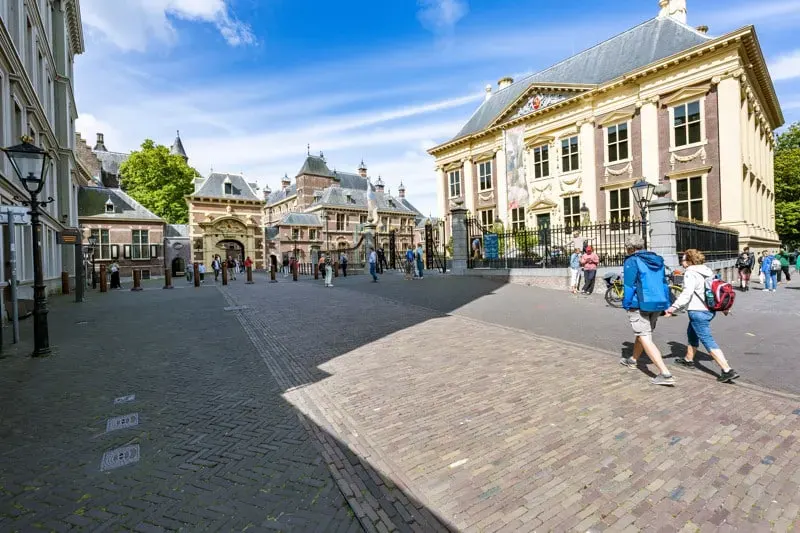
For many international visitors, the Netherlands can be confusing at first glance. Our parliament, senate, ministries, high court, and royal working palace are all located in The Hague, yet guidebooks and maps consistently identify Amsterdam as the capital. And the guidebooks are not wrong, but this does often raise questions among visitors. Let’s find out what happened.
The Hague as a sort of capital
The Hague is a unique case when it comes to city development. As opposed to many other Dutch towns and cities, The Hague actually didn’t start out as a medieval trading or fishing city, but as an administrative centre. All because the Count of Holland decided to build a sort of holiday palace in the middle of nowhere, as he enjoyed hunting in the surrounding forests. We’re talking about the mid-1200s, by the way. This palace complex became known as the Binnenhof.
As you can imagine, when the most powerful man of Holland sets up a palace somewhere, this attracts an entire entourage of opportunistic noblemen, traders, and farmers alike. Soon, a small town emerged, known initially as Die Haghe, meaning “the hunting ground” in Old Dutch.
For centuries to come, the Counts of Holland ruled from the Binnenhof, which gradually became the seat of regional and later national governance. The Hague was the place where power was exercised. Remarkably though, it did not receive city rights, including the right to build defensive city walls, as this was not in the interest of the Counts of Holland.
Later, when the independent Dutch Republic emerged in the late 1500s, the political situation changed. Holland became the most powerful of seven united provinces within a confederate republic, where political power rested with the cities, provinces and their representatives in the States General, which met in the Binnenhof in The Hague.
Amsterdam was by far the richest and most influential city, but that very dominance made it politically sensitive. Designating Amsterdam as the seat of government would have given one city disproportionate influence over the republic. The Hague, lacking a powerful merchant class, was seen as a more neutral location for governance. It allowed statesmen and representatives to deliberate at a distance from commercial pressure.
The French Period
The modern concept of a capital city emerged relatively late in Dutch history. In 1806, during the French period in our history, Amsterdam was declared the capital of the “Kingdom of Holland.” This was done by our first real king, the foreign Louis Napoleon, who had been appointed by his big brother, the self-proclaimed emperor.
Louis liked Amsterdam more than the smaller The Hague, as it was more suitable for a proper king of his stature. He was just still lacking a proper palace in Amsterdam, so he decided to confiscate Amsterdam’s City Hall, a symbol of civilian power and pride from the 17th century, and turned it into a palace: the current Paleis op de Dam.
At the same time, there was no appetite to relocate the entire government apparatus to Amsterdam. The Hague already housed the institutions, archives, and diplomatic corps needed to run the country. Moving them would have been costly and unnecessary.
A lasting compromise
Luckily we eventually got rid of the French, and the independent Kingdom of the United Netherlands was officially established in 1815. It even included Belgium back then. Time to return the palace to the city of Amsterdam, you’d say, and officially declare The Hague the national capital. (Brussels would have made more sense back then actually, but that’s not the point of this article!)
However, the Amsterdammers didn’t want their former city hall back. A lot of effort and money would be required, and it would also be nice to have a royal palace in the city, they thought.
And in the end, the Dutch Constitution confirmed Amsterdam as the official capital, while allowing the government, parliament, and ministries to stay in The Hague. Rather than concentrating all power in one city, the country maintained a clear division between symbolic capital and political centre.
Nowadays, this makes The Hague very different from Amsterdam. Instead of grand canals built by merchant wealth, you encounter quiet squares, government buildings, and royal residences that are still in use today.
Why this matters for visitors
The fact that The Hague is not the capital sometimes leads international visitors to underestimate it. Yet understanding this distinction helps explain why the city feels different: more restrained, a bit more formal, and sometimes more elegant than Amsterdam.
Exploring The Hague with a knowledgeable local guide brings these layers to life. The story of why the government is here, how the Binnenhof has functioned continuously for centuries, and how international diplomacy shaped the city is not always obvious when walking alone.
For travellers interested in Dutch history, politics, and culture, The Hague offers insights that no other Dutch city can provide.